Choose a turnaround point before walking
Let your child choose a visible landmark as the turning point. Returning along a familiar stretch makes the remaining distance easier to understand and leaves room to stop before a small child is exhausted.
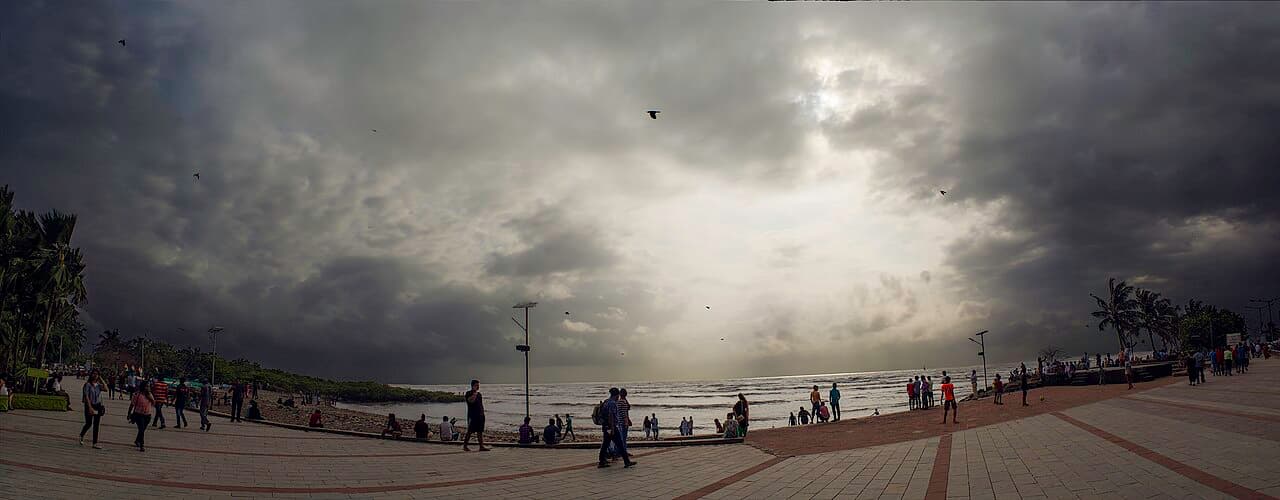
Bandra’s rocky western edge gives children an immediate sense of Mumbai as a coastal city: dark shore rocks, sea spray, an open horizon and a paved promenade threaded between the water and the neighbourhood.
1 photo · Mayur Thakare · CC BY 2.5 · Photos are representative and may not show current conditions. Credits →
Desk research, not a site visit. Re-check the official notice on the morning you travel.
Bandra’s rocky western edge gives children an immediate sense of Mumbai as a coastal city: dark shore rocks, sea spray, an open horizon and a paved promenade threaded between the water and the neighbourhood. Make this a short, flexible outing rather than a beach day. The most rewarding family rhythm is to walk one manageable stretch, stop for a sea-view sketch or photograph, then turn back before small children become tired. The restoration architect describes a stone-paved waterfront with seating, steps and a central garden. That describes the design, not a current accessibility inspection; check the actual surface and barriers when you arrive. Avoid building the outing around celebrity sightings. Those are unpredictable and waiting outside private homes adds little to a child’s visit.
All ages for a short accompanied walk. Toddlers need close supervision beside steps, road crossings and the sea edge; school-age children can compare rock shapes and wave patterns.
Bandstand works when the family wants a short sea-view walk. It is less satisfying when a child has been promised a playground, sand beach or long list of activities.
Let your child choose a visible landmark as the turning point. Returning along a familiar stretch makes the remaining distance easier to understand and leaves room to stop before a small child is exhausted.
The interesting rock shapes and waves can be observed without climbing down. For a child who constantly wants to approach the water, close adult attention will shape the visit more than the view itself.
A stroller may help on usable stretches, but the guide has not verified a continuous smooth route. Test the first section and identify the return path before treating the promenade as a long accessible circuit.
A short coastal outing built around the paved promenade and rocky views. These are self-guided family ideas, not ticketed attractions.
Start with one short out-and-back stretch. Pause where the horizon opens up and let children compare the sound and shape of successive waves. The natural-stone paving documented by the restoration architect is part of the experience; inspect uneven sections before taking a stroller farther.
The dark rock formations explain why Bandstand feels different from Juhu. Look from the promenade for ridges, gaps and changing water coverage. Make a sketch without climbing down: an apparently dry rock is not proof of safe footing or predictable waves.
Give each child one small scene to draw: a wave, a patch of sky or the meeting of buildings and sea. This is a family activity you organise yourselves, with no booking or equipment hire required. Stop before drawing becomes a compulsory lesson.
A longer outing can continue toward the southern neighbourhood, but fort entry and any separate garden access must be checked independently. Families with tired walkers should finish at their agreed pickup landmark rather than assume there is an easy exit at every point.
Editorial pacing advice; allow for queues, weather and your family’s energy.
Prices, access and programmes can change. Confirm with the operator before setting out.
Bandstand Promenade, Bandra West, Mumbai
Search-based Google map. Confirm the public entrance before travelling; this is not a surveyed entrance pin.
Plan for a promenade and rocky shore. If sand play is the main purpose of your day, choose a beach outing instead; do not climb down between rocks looking for a play area.
Keep children on the promenade. A receding tide does not remove slippery surfaces, uneven gaps or the risk of waves. The rocks work better as an observation subject than a climbing route.
That is an unpredictable use of family time and can create crowding near private homes. Give children a more reliable activity: count wave sets, draw the coastline or spot differences in rock shapes.
It can be a separate stop near the southern end, but check its current entrance arrangements and opening status first. Do not assume that promenade access also guarantees access to the fort.
Set a very short challenge: find three kinds of waves, choose a favourite sea colour and sketch one rock formation. Finish the walk when the challenge is complete rather than insisting on the full waterfront.
Do not assume it is. Sunset is an attractive visiting time and can bring crowds. A dry weekday morning is a planning option if your priority is a calmer, shorter walk.
No current full-route access audit was found. Inspect the entry, paving and any steps before committing to a long stretch, and be ready to turn around.
Save the same clearly identifiable roadside landmark used for your drop-off, or choose another legal stopping point before you begin. Avoid arranging a pickup that requires children to cross moving traffic unexpectedly.
Practical family suggestions are editorial planning advice. Unconfirmed facilities and operating details are explicitly identified.
Tell us what has changed: new hours, a price, a closed gallery, a changing table that exists or doesn’t. We check against a source before publishing.
Consider one of these if there is time and energy left. They are alternatives; the route link lets you check the journey before adding a stop.
45–75 minutes · Outdoor
Carter Road is a useful family counterpoint to a monument-heavy Mumbai itinerary: the experience is a waterfront walk, a conversation and a manageable pause outdoors. Check its own opening and access notes before adding a second stop.